A control unit whose firmware is generated for your vehicle
NewVCU runs the vehicle's traction, safety and communication. You do not write it in C: you describe it in VCU Forge (vehicle, motor, battery, inverter, features), and Forge generates the firmware, builds it, checks it and flashes it. A new motor or inverter is added as a catalogue entry.
Two controller tiers
NewVCU
[RIDDEN]The test motorcycle's controller, riding since September 2026.
- Processor
- ARM Cortex-M4F, 168 MHz
- CAN buses
- 2, at 500 kbit/s
- Inputs
- Analogue, digital, wheel speed
- Sensors
- Inertial unit, GPS
- Data
- SD card logging, MoTeC i2 export
- Tuning
- Bluetooth and from the display
NewVCU higher tier
[SOFTWARE-TESTED]For racing: replacing a motorsport ECU on an electric car with three CAN buses. The firmware builds; it has not yet run on a board.
- Processor
- ARM Cortex-M7, 550 MHz
- CAN buses
- 3 (FDCAN)
- Inputs
- Up to 18 analogue channels
- Logic
- Ported from Simulink, compared step by step with the original code
Dedicated board, in design
[IN DESIGN]A 4-layer 100 x 80 mm board: sealed 35-way automotive connector, two CAN buses, 12 V supply, inertial unit, microSD, low-side power outputs, USB-C. The render shows the design; the board is not manufactured yet.
Inverters
- VESC controllers, current-commanded over CAN [RIDDEN]
- OpenInverter, commanded over CAN [SOFTWARE-TESTED]
- Any inverter described by a DBC profile [SOFTWARE-TESTED]

From the datasheet to a vehicle that rides
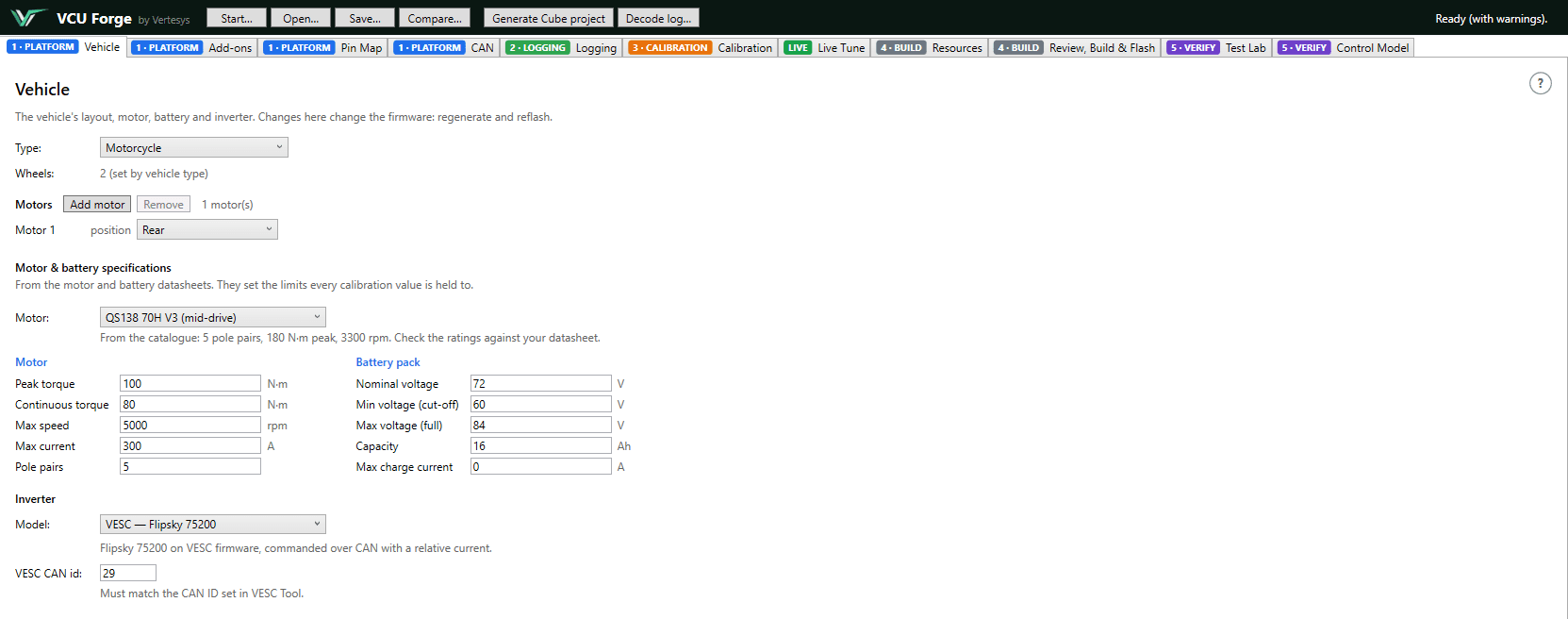
- Describe the vehicle
- Tick the features
- Let Forge wire it
- Tune in real units
- Generate and flash
- Verify on a PC
Describe the vehicle
Type, motors, battery and inverter. The datasheet's limits bound every setting.
Tick the features
Drive modes, regen, traction control, limiter, logging: a catalogue of features to tick.
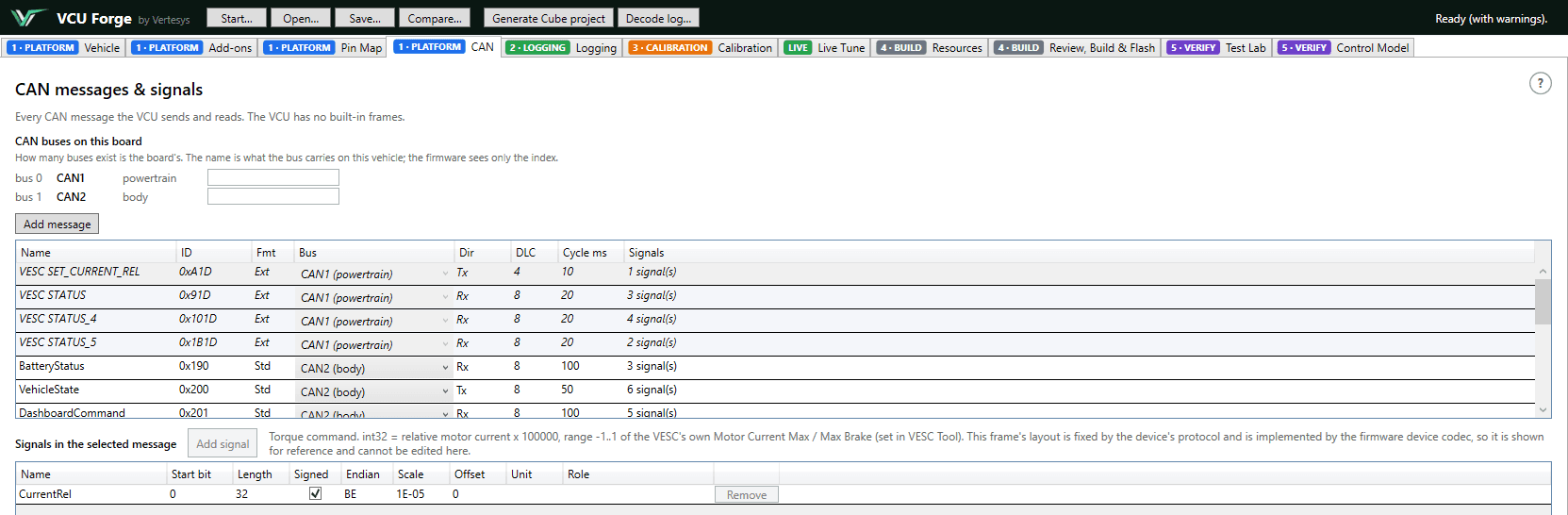
Let Forge wire it
Pins assigned automatically, without conflicts. CAN messages described as data, never hard-coded.
Tune in real units
Maps and thresholds in km/h, amps and degrees, edited with the mouse, saved apart from the validated platform.
Generate and flash
Project generated, built with no errors or warnings, flashed over USB, without opening the chip vendor's tools.
Verify on a PC
Every check runs from one button, and the control loop is replayed scenario by scenario before it touches the vehicle.
Vehicle protection
- Brake overrides throttle, and a vehicle with no brake sensor refuses to start.
- Two-step arming before any traction.
- Monitoring of the inverter, pedal plausibility, battery voltages and temperatures, with progressive derating.
- Hardware watchdog, proven on the motorcycle.
- A fault book, readable from the display and in the logs.
- Live settings bounded by the firmware itself: an out-of-range value is refused, whatever sent it.
Checked before it ships
Every release goes through a battery of automatic checks: the logic tested function by function, two static analysers, a build without a single warning, and a closed loop where the real safety and control functions run against a model of the vehicle, fault scenarios included.
Release of 14 October 2026.
A green loop proves the software does what is specified, not that the vehicle behaves like the model. Real testing is still required.