Display pages drawn from your own DBC
NewDash reads your vehicle's CAN bus and shows what you decide. Its pages are drawn in DashForge, online: import your DBC, place gauges, alerts and buttons, then send the project to the screen. No page is compiled into the firmware: a changed signal does not need a new release.
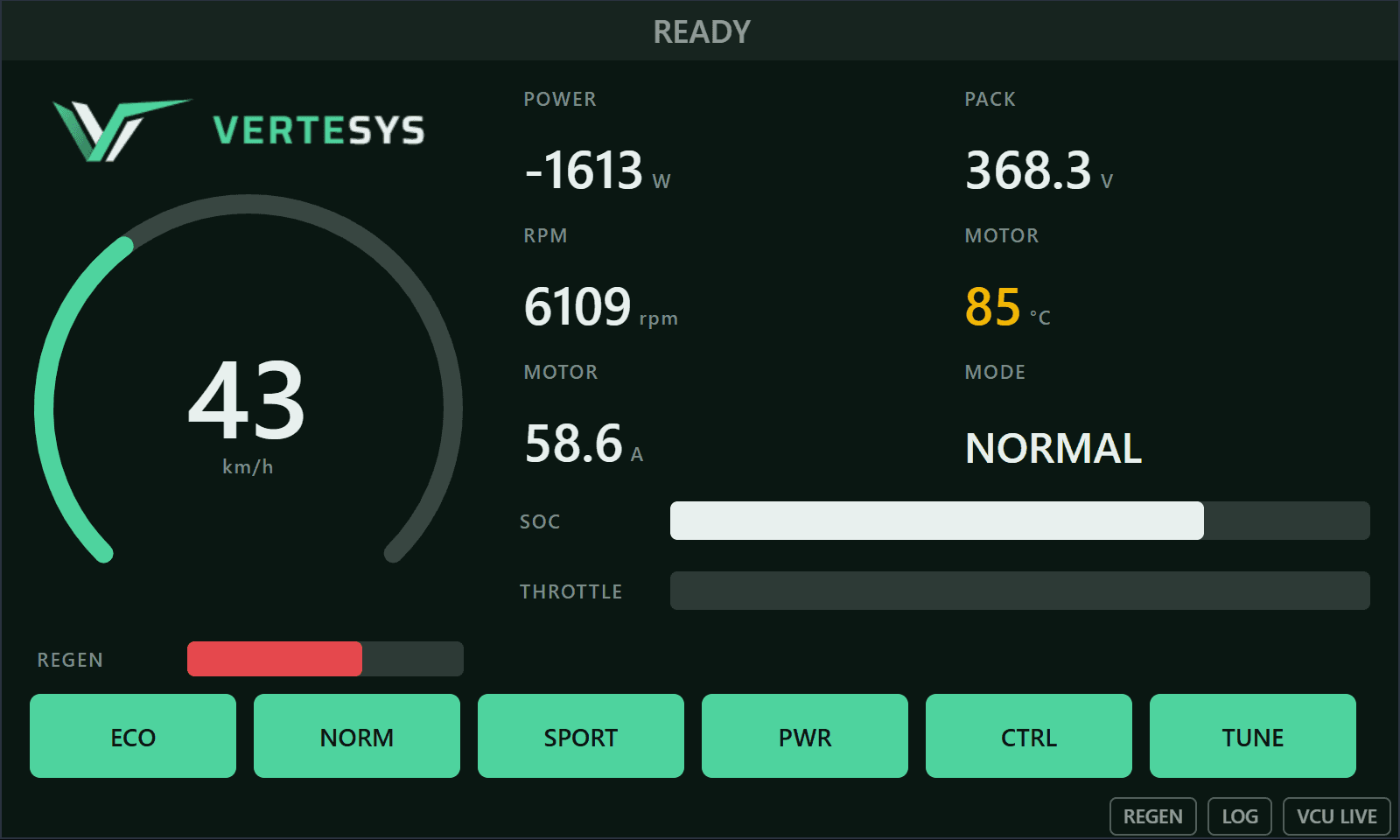
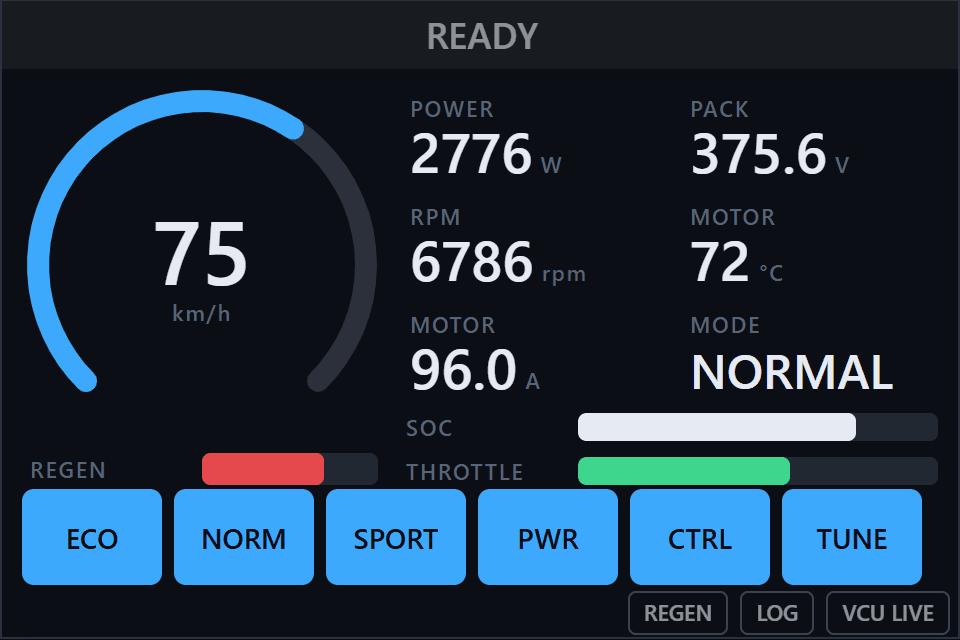
Everything happens in the browser
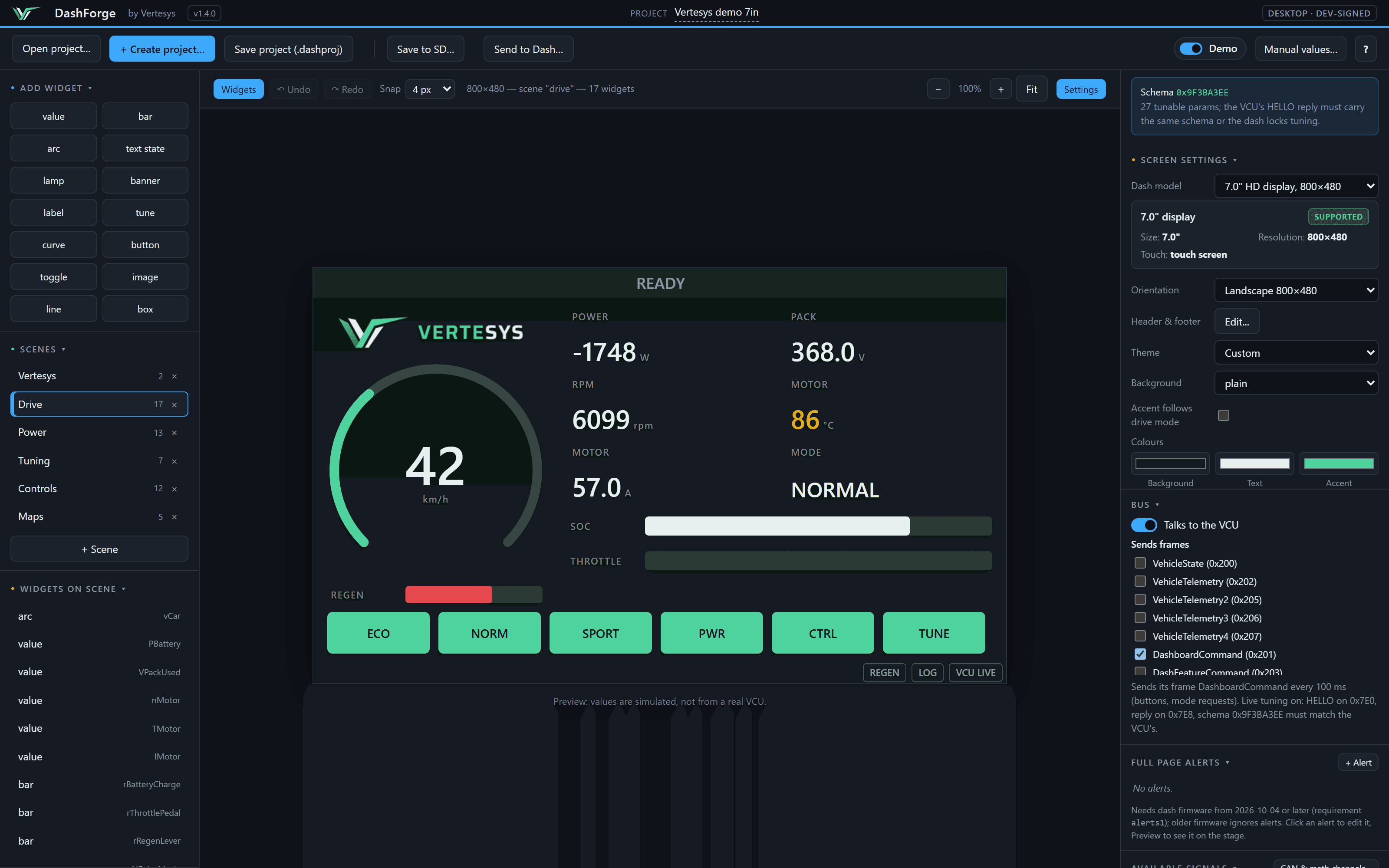
- Your DBC, your signals
- Import a standard DBC file: received and sent messages, every frame shown byte by byte, Intel and Motorola.
- Widgets and pages
- Values, bars, arcs, lamps, text states, curves, buttons, images. Several pages, header and footer, light and dark themes.
- Calculated channels
- Power, range, averages: expressions over your signals, computed by the display itself.
- Alerts
- Full-screen or banner alerts on a threshold, with delay and hysteresis on the display. Previewed in demo mode.
- Demo and manual values
- See the page with simulated values, or pin each signal by hand: empty battery, hot motor, active fault.
- Teams and shared projects
- Named accounts, roles, team projects online. Exports are signed and the display only accepts your team's.
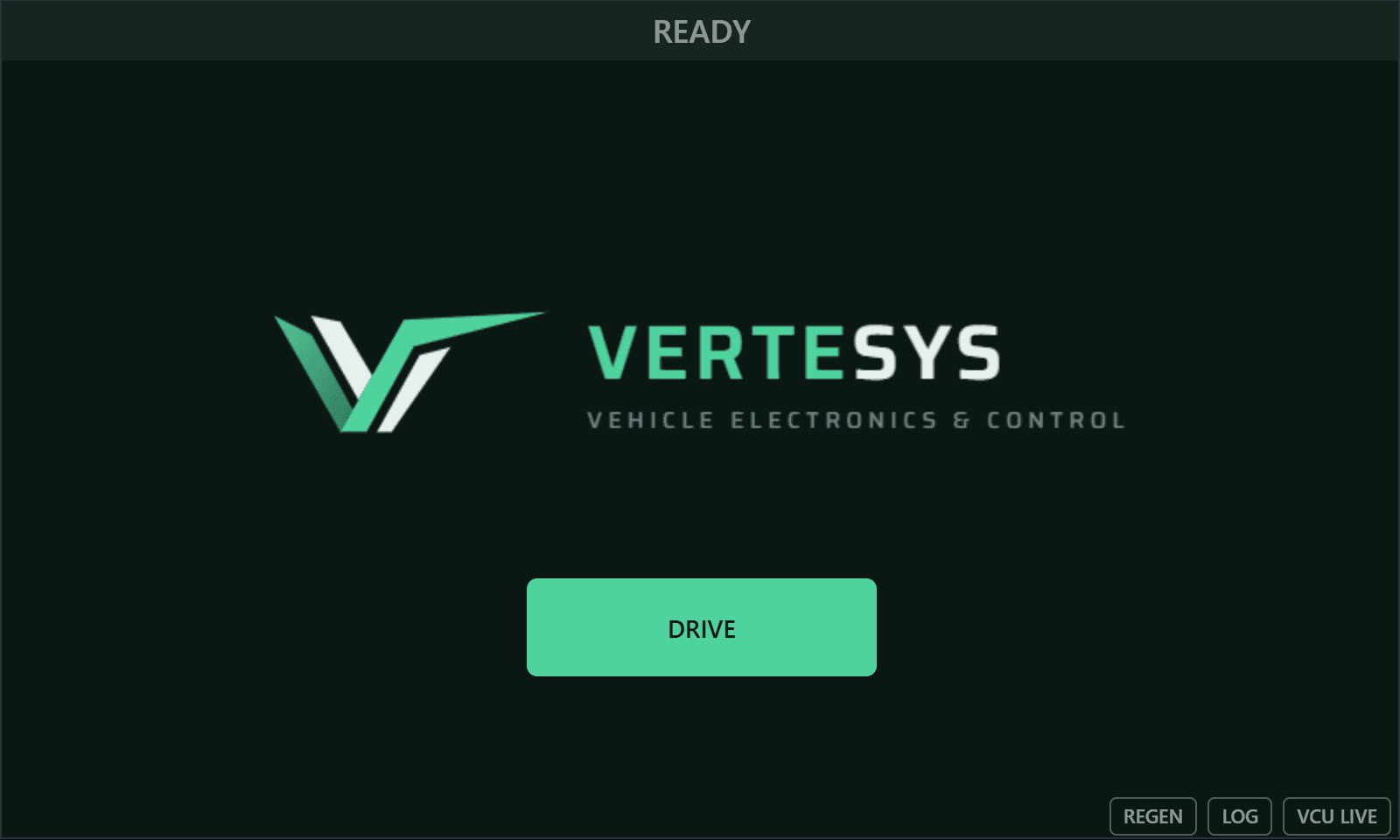
Your logo, your colours
A page can carry your logo, and the theme takes your colours. Our own demo dash opens on a brand page with a button to the driving pages. In DashForge Cloud, your team saves its logo and colour once, and DashForge builds a starter project that already carries both.
With the Vertesys controller
Connected to NewVCU, the display does more than read: drive-mode selection, live parameter tuning (the controller checks every limit), throttle calibration from the screen. On another controller it stays a silent display that sends nothing on the bus.
Three displays, one per kind of vehicle
All three share the same DashForge pages: a layout moves from one format to another. Choose by the vehicle and what it has to put up with.
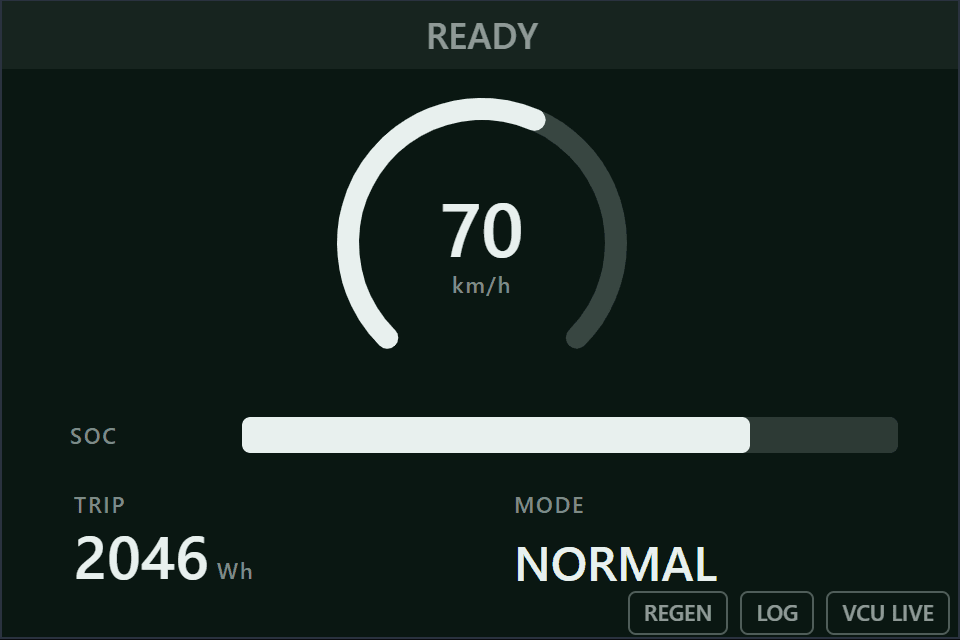
One page: speed, charge, trip, mode
Dash S
from EUR 199Eco-marathon, karts, light electric bikes and motorcycles, school projects
- About 4 inches
- Light housing
- Touch
Driving page, in the team's colours
Dash M
from EUR 349Motorcycles, pit bikes, quads
- 4 to 5 inches, sunlight-readable
- Sealed housing
- Handlebar mount
- 2 to 4 buttons
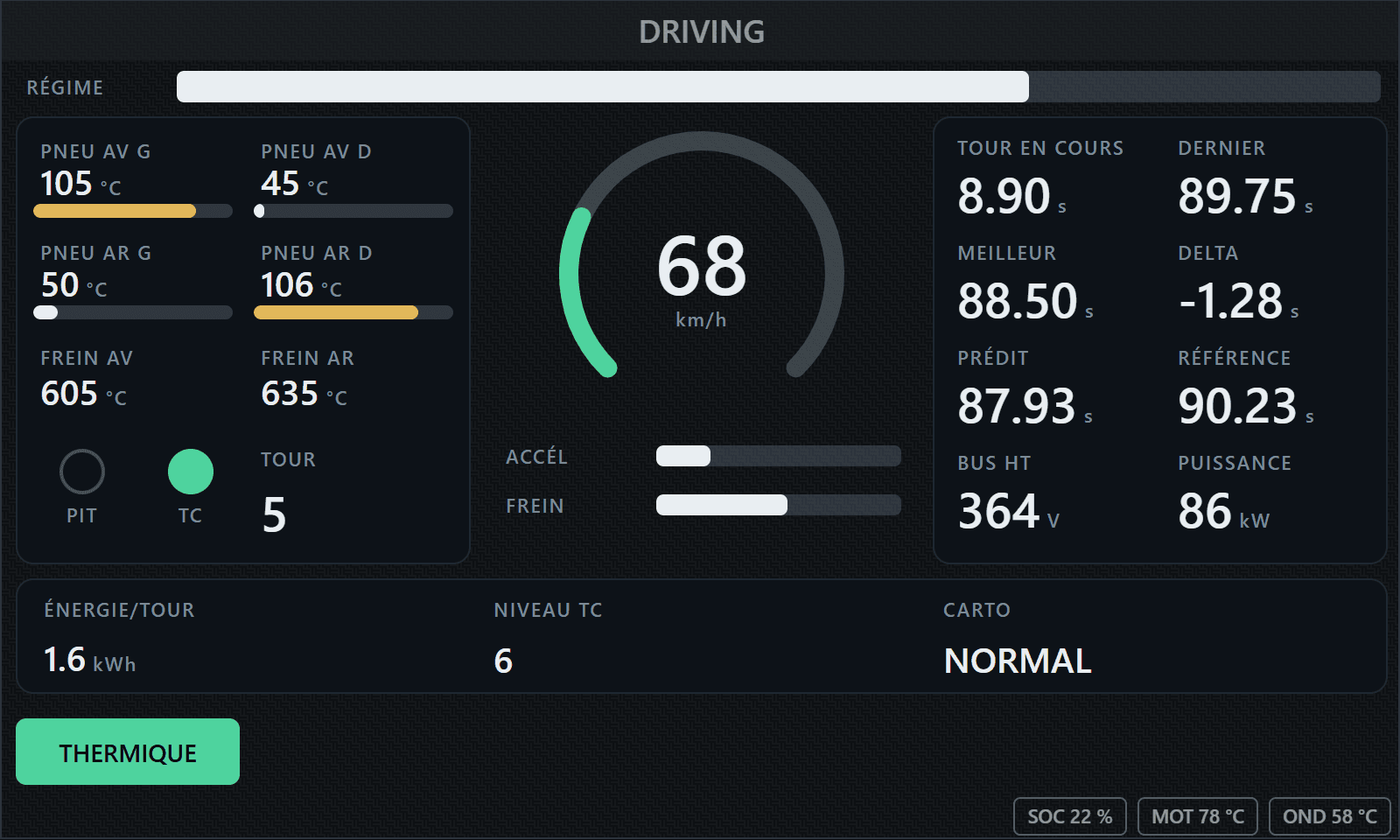
Race page: tyres, brakes, timing
Dash L
from EUR 599Cars, club racers, workshop conversions
- 7 inches, touch
- Sealed housing
- Motorsport connector
Prices excluding VAT, starting from. Every offer is confirmed in a written quote.
Dash S has been riding on our test motorcycle since September 2026, and the 7-inch runs on the bench with its pages. The dates are those of the finished products, housing and connector included.
Real captures of our demo dash; the values are simulated by DashForge's demo mode.
Options
All three displays carry the same electronics: a feature is unlocked on the display, with no change to the wiring. The detail per model is on the pricing page.
- Data logging, EUR 99 (included on Dash L)
- Extra inputs and outputs, EUR 79 (included on Dash L)
- GPS and lap timing, EUR 79
- Shift-light LED bar, EUR 99 (Dash M and L)
- Motorsport connector, EUR 49 (included on Dash L)
- Live telemetry and fleet tracking over 4G, on request (Dash M and L)
What the display is not yet
- No type approval of its own: neither EMC (UN R10) nor speedometer (UN R39). On a road vehicle it does not replace the approved speed indicator.
- No declared ingress rating. Board operating range: 0 to 65 °C.
- Outside every command or protection chain: it acts on neither torque, brakes nor battery.
That evidence is the product's next step. We would rather write it here than have you find out in testing.
The software is free
The DashForge app is free, with no account: the full editor, every widget, export to the screen, even offline. The Cloud plans, from EUR 99 a year, add the browser editor and projects shared between team members.
Be told when it ships
Tell us which display you want. We write to you when it is available.